Home Cinema 2350 Specs, Features, and Value: Is it worth the price tag?
For enthusiasts looking to make the leap from a standard television to a massive, cinematic display, the Epson Home Cinema 2350 represents a pivotal junction in the projector market. As a 4K PRO-UHD Smart Gaming Projector, it attempts to bridge the gap between two traditionally separate worlds: high-fidelity home cinema and high-performance gaming. In an era where living rooms are increasingly doubling as dedicated media hubs, the demand for a versatile, bright, and responsive projection system has never been higher. This article provides an exhaustive analysis of the Home Cinema 2350, dissecting its technical specifications, real-world utility, and overall value proposition to determine if it truly justifies its position in your entertainment setup.
The Evolution of the Home Cinema Line
Epson has long dominated the mid-range projector market with its Home Cinema series, known for balancing cost with color accuracy and brightness. The Home Cinema 2350 is a strategic evolution, designed to address the modern viewer's desire for "smart" capabilities and lower latency for gaming. Unlike its predecessors which often required external streaming sticks or had input lag that frustrated competitive gamers, the 2350 arrives with integrated Android TV and a dedicated focus on 4K enhancement. It sits as a more accessible alternative to the higher-end Epson LS series while offering a significant step up from the entry-level 1080p models that populate the budget market.
Technical Specifications and Core Technology
To understand the performance of the Home Cinema 2350, one must look at the foundation of its imaging technology. Epson utilizes a proprietary 3-LCD system. This is a critical distinction from the Digital Light Processing (DLP) technology found in many competitors. In a 3-LCD system, the projector uses three individual liquid crystal panels to process the primary colors—red, green, and blue—simultaneously. This eliminates the "rainbow effect" (color breakup) that some viewers experience with single-chip DLP projectors, ensuring a much smoother and more stable image for sensitive eyes.
The resolution is marketed as 4K PRO-UHD. It is important for potential buyers to understand that this is achieved through advanced pixel-shifting technology. While the native resolution of the LCD chips is 1080p, the projector shifts each pixel diagonally at an incredibly high frequency to double the pixel count on the screen. The result is an image that is significantly sharper and more detailed than standard 1080p, though physically different from a "native" 4K chip, which would be substantially more expensive. This technology also allows for full HDR10 and HLG support, ensuring that high-dynamic-range content from 4K Blu-rays or streaming services retains its intended luminosity and shadow detail.
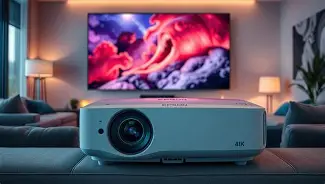
| Feature | Specification Details |
|---|---|
| Projection System | Epson 3-LCD, 3-chip technology |
| Resolution | 4K PRO-UHD (via Pixel Shifting) |
| Brightness | 2,800 Lumens (Color and White Brightness) |
| Contrast Ratio | Up to 35,000:1 |
| Gaming Latency | Under 20ms (supporting 4K/60Hz) |
| Smart OS | Integrated Android TV with Voice Search |
| Audio | Built-in 10W Bass Reflex Speaker |
| Light Source | High-efficiency UHE Lamp (up to 5,000 hours in Normal Mode) |
Key Features and Performance Analysis
Brightness and Ambient Light Handling
One of the most praised aspects of the Home Cinema 2350 is its 2,800 lumens of brightness. In the world of projectors, brightness is king, especially for users who do not have a pitch-black, dedicated basement theater. A rating of 2,800 lumens means that even with some ambient light—such as daytime viewing with the curtains drawn or a few lamps on in the back of the room—the image remains vibrant and visible. Many "cinema-focused" projectors sacrifice brightness for black levels, leading to a washed-out image during the day. The 2350 strikes a balance that favors the lifestyle user who wants to watch a Sunday afternoon football game without total darkness.
Gaming Capabilities: The "Gaming" Label Explained
Projectors have historically been the enemy of the gamer due to high input lag—the delay between pressing a button and seeing the action on the screen. The Home Cinema 2350 targets this specifically with a lag time under 20 milliseconds. For a projector, this is an impressive feat. While professional e-sports players might still prefer a 1ms monitor, for the average console gamer playing Call of Duty, Elden Ring, or Madden, the experience is fluid and responsive. Scaling a gaming session up to 120 or 150 inches creates an immersive experience that no 65-inch television can replicate, particularly in split-screen multiplayer scenarios.
The Smart System: Android TV Integration
By including a built-in Android TV interface, Epson has turned the 2350 into a plug-and-play device. Out of the box, users have access to major streaming platforms like YouTube, Disney+, and Hulu. This reduces cable clutter, as the user doesn't strictly need a separate streaming box. However, experienced home theater users should note that, like many integrated systems, the hardware running the smart OS can eventually become dated compared to dedicated sticks. Furthermore, certain high-profile apps occasionally have compatibility nuances on projector-based Android TV versions, so keeping a spare HDMI port open for a premium streamer is still a wise move for the long term.
Real-World Use Cases
The Family Living Room Setup
Consider a typical Friday night movie marathon. In a room with beige walls and a few windows, the Home Cinema 2350 excels because of its color brightness. Because the 3-LCD technology produces 100% of the RGB color signal for every frame, the colors don't lose saturation as the brightness increases. This means animated films look spectacular, with "pop" and vibrancy that keeps children and adults alike engaged. The wide lens shift capabilities (vertical displacement) also mean the projector can be placed on a coffee table or a bookshelf without needing to be perfectly centered with the screen, making it "living room friendly."
Discover deals on Electronics — updated daily.
Shop Amazon →The Weekend Combatant: Immersive Gaming
For the gamer, the use case is about scale. Playing an open-world RPG like The Legend of Zelda or Horizon Forbidden West on a 130-inch screen allows the player to see details in the environment that are often lost on smaller displays. The 2350 supports 4K at 60Hz, which is the sweet spot for the current generation of consoles (PlayStation 5 and Xbox Series X). While it doesn't support 4K/120Hz (a feature usually reserved for ultra-high-end HDMI 2.1 displays), the 60 frames per second at 4K resolution provides a sharp, cinematic smoothness that satisfies most high-end gaming needs.
Pros and Cons
Every piece of technology involves trade-offs. The Home Cinema 2350 is designed to be a "jack of all trades," which necessitates certain compromises in specialized areas. Below is a breakdown of what makes it shine and where it might fall short for demanding users.
- Pro: Exceptional Color Brightness — The 3-LCD technology ensures that the white brightness and color brightness are equal, prevent…
Room Environment
If you have a dedicated, windowless room with dark walls and a high-quality fixed screen, you might find the 2350's black levels to be its weakest link. In such an environment, you would be better served by a projector that prioritizes contrast over raw brightness. However, if your room is a "multi-purpose" space with light-colored walls and some ambient light, the 2350 is almost tailor-made for you. Its high lumen output is designed to fight through less-than-ideal lighting conditions.
Screen Choice
While you can project onto a white wall, the Home Cinema 2350 benefits significantly from a proper screen. Because its black levels are not its strongest suit, pairing it with a Grey Screen or an Ambient Light Rejecting (ALR) screen can help perceived contrast. The grey surface absorbs more of the stray light in the room, making the dark parts of the image look deeper without significantly sacrificing the 2350’s ample brightness.
Maintenance Expectations
Buyers should be aware of the "lamp life" factor. The 2350’s lamp is rated for approximately 5,000 hours in normal mode and up to 15,000 hours in ECO mode. For most users, 5,000 hours represents about 3 to 5 years of heavy use. Replacing a lamp is a straightforward process, but it is an added cost that laser projectors (which last 20,000+ hours) do not have. If you plan to use this as your primary "TV," running 8–10 hours a day, the maintenance costs are something to budget for.
Connectivity and Sound
The projector features two HDMI ports, one of which supports ARC/eARC. This is crucial because, as mentioned, the internal 10W speaker is underwhelming. Using the HDMI (ARC) port allows you to send high-quality audio back to an AV receiver or a soundbar with a single cable, ensuring that the sound is as big as the 150-inch image. If you plan to use Bluetooth headphones for late-night viewing, the built-in Android TV supports Bluetooth out, which is a convenient feature for private listening.
Shop the latest Electronics picks on Amazon.
Shop Amazon →Comparing the Competition
In the sub-$1,500 4K श्रेणी, the Home Cinema 2350 competes with several DLP-based "lifestyle" projectors. While many of those competitors are smaller (often called "smart portable projectors"), they frequently suffer from lower brightness once color is accurately calibrated. The 2350’s advantage is its "bulk"—it has a larger chassis and a larger lens, which generally translates to better cooling and a more stable image. If you prioritize "set it and forget it" portability, there are smaller options, but for a permanent or semi-permanent home theater, the 2350’s glass and processing power hold the edge.
The Verdict: Is it Worth the Price Tag?
Determining value in the electronics market is about matching features to needs. The Epson Home Cinema 2350 is positioned as a "performance value" model. It gives you 90% of the experience of a $3,000 professional projector for roughly half the price, provided you are willing to accept the limitations of lamp-based light sources and non-native 4K resolution.
For the family that wants to host "Super Bowl" parties or backyard movie nights, the value is undeniable. The high brightness ensures the image doesn't disappear when a light is turned on. For the gamer who wants to be "inside" their favorite game on a screen that fills their entire field of vision, the low latency makes this one of the few projectors that doesn't feel like a compromise. However, for the "dark room" purist who counts every pixel and demands absolute black, the 2350 might feel like it leans too far into the lifestyle/gaming category.
Ultimately, the Home Cinema 2350 is worth the price for the versatile user. It is a workhorse that handles streaming, live sports, and modern gaming with equal competence. It doesn't try to be a professional cinema machine; it tries to be the ultimate entertainment center for the modern home. In that specific mission, it succeeds brilliantly by providing a massive, bright, and colorful image that simply makes viewing content more fun.
Conclusion
The Epson Home Cinema 2350 stands as a testament to how far consumer-grade projection technology has come. By successfully integrating low-latency gaming features with a bright 3-LCD 4K PRO-UHD heart, Epson has created a device that serves multiple masters. While it may not satisfy the most stringent audiophiles or those seeking "infinite" contrast ratios, its strengths in color accuracy, setup flexibility, and sheer output make it a formidable contender in its class. For those ready to move beyond the constraints of a traditional television, the 2350 offers a gateway into the world of "big screen" entertainment that is easy to use, exciting to play on, and visually impressive enough to turn any room into a true home cinema.